










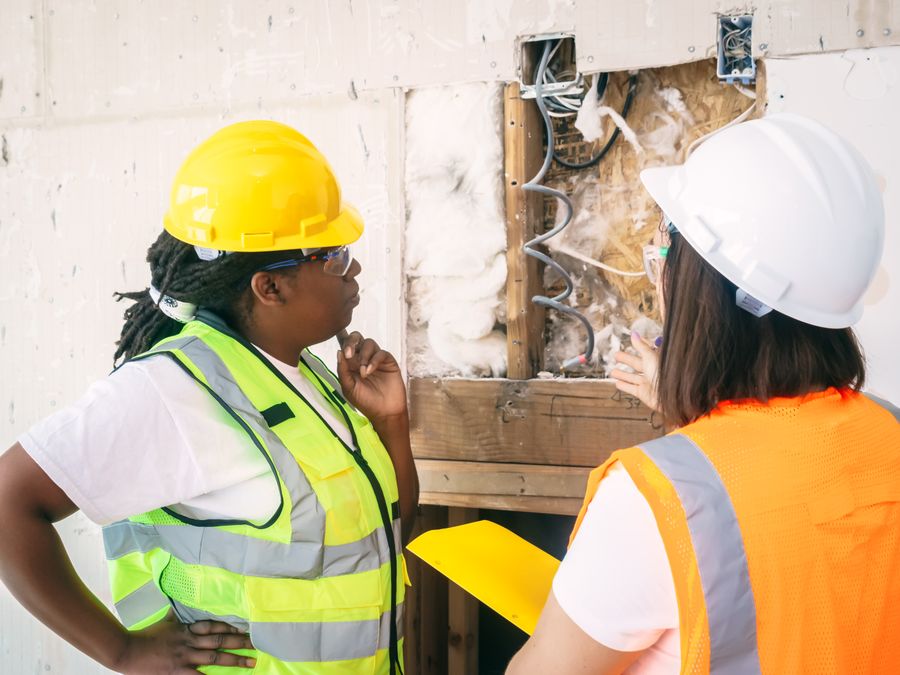
Ask three different superintendents to estimate the percent complete on a mechanical rough-in, and you will get three different numbers. One eyeballs the installed ductwork and says 65%. Another counts the rooms with completed rough-in and says 58%. A third checks against the planned labor hours and says 71%. All three are trying to answer the same question, and none of them has a method that is both consistent and accurate.
The Problem With Manual Progress Reporting
Percent-complete reporting drives everything downstream in construction project management. It determines earned value calculations, progress payment applications, schedule forecasting, and resource planning. When the percent-complete numbers are inaccurate, every downstream decision is based on bad data.
Research from the Construction Industry Institute found that manual percent-complete estimates on active construction projects deviate from actual progress by an average of 12 to 15 percentage points. The bias is almost always toward overreporting progress. Superintendents, often unconsciously, report higher completion percentages than reality because they are optimistic about catching up on minor delays and because lower-than-expected progress triggers uncomfortable conversations with owners and project managers.
This overreporting accumulates. A project that consistently reports 5% more progress than actual over 6 months builds a gap between reported and real status that eventually surfaces as a schedule or cost surprise. By the time the gap becomes undeniable, recovery options are limited and expensive.
How AI Measures Progress
AI progress tracking uses multiple data sources to calculate percent complete without relying on subjective human estimates. The most common approaches include photo-based analysis using computer vision, 3D point cloud comparison from laser scans or photogrammetry, IoT sensor data from installed systems, and material tracking from delivery and installation records.
Photo-based progress tracking is the most accessible. Superintendents or site photographers take structured photos on a regular schedule, following defined photo paths through the building. Computer vision algorithms compare these photos against the design model and previous photos to identify what has been installed since the last capture.
A platform specializing in photo-based progress tracking tested their accuracy across 85 commercial construction projects. Their AI-calculated percent complete averaged within 3.2 percentage points of actual progress measured through detailed physical surveys. Manual superintendent reports on the same projects averaged 11.8 percentage points deviation from the physical surveys.
3D Scanning for Higher Precision
Laser scanning and photogrammetry provide higher accuracy than photo-based methods but require more equipment and processing time. A weekly laser scan of a construction floor can be compared against the BIM model to identify exactly which elements have been installed, partially installed, or not yet started.
The AI compares the scan point cloud against the design model and calculates installation percentages for each building system. Structural steel 94% complete, mechanical ductwork 67% complete, electrical conduit 52% complete. These numbers are based on physical measurement rather than estimation, which makes them more defensible in progress payment disputes and more reliable for schedule forecasting.
The trade-off is cost and effort. Weekly laser scanning on a large project requires either a dedicated scanning technician or a service contract, typically costing $2,000 to $5,000 per scan depending on project size. For projects over $20 million, this cost is easily justified by the improved accuracy of progress tracking and its downstream effects on cash flow management.
Material and Labor Data Integration
AI progress tracking becomes more accurate when it combines visual data with material and labor records. If the delivery log shows that 80% of the specified ductwork has been delivered to site, and the photo analysis shows 60% appears to be installed, the system can infer that 20% is on site but not yet installed. This gives the project team a more nuanced picture than either data source alone.
Labor hour tracking provides another calibration point. If the mechanical subcontractor has burned 70% of their budgeted labor hours but the visual analysis shows 55% installation progress, the productivity is below plan and the activity is likely to overrun its labor budget. This early identification allows intervention before the overrun becomes severe.
Contractors adopting AI-based construction project tracking find that the integration of multiple data sources is what makes the progress reporting trustworthy. No single source is perfect, but the convergence of visual, material, and labor data creates a progress picture that is significantly more accurate than any manual method.
Impact on Pay Applications
Progress payment applications are one of the most contentious aspects of construction project management. Subcontractors want to bill for as much completed work as possible to maintain cash flow. General contractors want to ensure they are not overpaying against actual progress. Owners want assurance that the reported progress justifies the requested payment.
AI-verified progress data provides a neutral reference point for these discussions. When the pay application says 72% complete and the AI-measured progress shows 68%, the 4-point gap is small enough that it might reflect legitimate differences in measurement methodology. When the pay application says 72% and the AI shows 54%, there is a significant discrepancy that warrants discussion before payment is approved.
Several GCs report that AI progress tracking has reduced pay application disputes by 30 to 40% because both parties are working from more objective data. The superintendent still has a role in interpreting the numbers and accounting for work that the AI might not fully capture, such as testing and commissioning activities that are not visually apparent. But the baseline measurement is more reliable.
Practical Implementation
The simplest entry point for AI progress tracking is structured photo documentation. Many contractors already take daily photos for documentation purposes. Adding structure to those photos, defined paths, consistent angles, and regular schedules, makes them usable for AI analysis with minimal additional effort.
The more advanced approaches, laser scanning and IoT sensor integration, make sense for larger projects where the cost is proportional to the project value and the accuracy improvement has meaningful financial impact. A $5 million tenant improvement probably does not justify weekly laser scanning. A $100 million hospital almost certainly does.
The transition from manual to AI-assisted progress tracking also requires a cultural shift. Superintendents who have spent their careers estimating progress based on experience and judgment need to trust, and learn to work alongside, data-driven measurements. The most successful implementations frame the AI as a tool that supports the superintendent's judgment rather than one that replaces it. The superintendent still provides context and interpretation. The AI provides the measurement baseline.